
WELCOME TO THE FIRST OFFICIAL ASSOCIATION OF ÍNDIO GIGANTE IN THE UNITED STATES
.jpg)

Correct Índio Gigante Body Type and Structure
The Índio Gigante is not simply a tall chicken.
Height is one of the breed’s defining characteristics, but correct type depends on the entire bird working together: head, neck, body, wings, tail, thighs, legs, feet and station. A bird may be exceptionally tall and still lack proper Índio Gigante structure.
Overall Type
The correct Índio Gigante should present a powerful, upright and harmonious silhouette.
The bird is long-legged and imposing, with prominent musculature, hard feathering and
enough body substance to support its height.
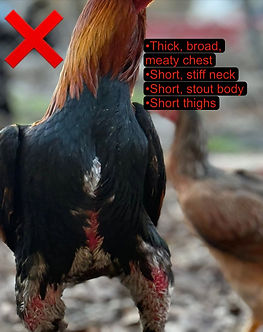
The body should not appear extremely narrow, weak or disconnected from the legs.
At the opposite extreme, it should not be excessively broad, low-set or heavily feathered
like a conventional meat breed. The objective is a balanced combination of height, length,
strength and athletic structure.
All sections should remain proportional. An extremely long neck on a short body,
enormous legs beneath a weak frame or excessive body mass carried on inadequate
bone does not create correct type.
Head and Facial Structure
The head should be medium to large, harmonious with the body and sufficiently broad through the skull. It should never appear extremely small, delicate or weak in relation to the bird’s size.
The profile of the head is influenced by a firm skull and a pronounced brow above the eyes. This creates the strong, serious expression associated with the breed. The brow should contribute to the expression without becoming so exaggerated that it obstructs the eyes or creates a deformed appearance.
The face is free of feathers and may be smooth or lightly wrinkled. Wrinkling is therefore not automatically a defect, but the skin should remain healthy and appropriate to the bird.
The eyes should be large, round and well set beneath the brow. Light-colored eyes have traditionally been preferred within the Brazilian standard, although the published Brazilian description permits different eye colors.
The beak should be strong, vigorous and slightly curved. It is generally described as medium in length in the Brazilian standard. It must be substantial enough to complement the skull, but it should not be so shortened or exaggerated that the bird develops a round, compressed or parrot-like head.
Both cushion, commonly called crista bola, and pea combs are recognized within the broader Brazilian breed. The comb should be firm, clearly formed and free from excessive twisting or drooping. Individual standardized varieties may be limited to one comb type.
The ear lobes should be oval, smooth and appropriately sized for the head.
Most importantly, wattles and the dewlap must not be confused. Wattles are the paired appendages located beneath the beak. In the Índio Gigante, they should be absent or very small, no more than approximately one centimeter. The dewlap is the single central fold of loose throat skin extending beneath the lower jaw and neck. It is a separate anatomical structure and contributes greatly to the characteristic mature Índio Gigante profile. Two large conventional wattles should never be mislabeled as a correct single dewlap.
A correct head is therefore not defined by one oversized feature. It is created by the relationship among the skull, brow, eyes, beak, comb, face, ear lobes and throat structure.
Neck and Transition into the Body
The neck should be long, upright and slightly arched. In the male, it may form a gentle
S-shaped curve, with the hackle flowing toward the shoulders. The female’s neck should
also be long and proportional, becoming finer as it approaches the head.
The neck should rise naturally from the shoulders. A neck carried strongly forward
produces the wrong balance and can make the bird resemble its gamefowl ancestors
more than the developed Índio Gigante. Completely straight, rigid carriage is also
undesirable. The correct neck combines length with a controlled natural arch.
Back and Body
The back should be medium to long, moderately broad and slightly arched,
narrowing toward the base of the tail. It should provide sufficient length
to balance the neck and legs.
The topline should flow from the shoulders toward the tail without appearing
hollow, sharply broken or excessively roached. The body should remain elevated
because of the bird’s leg length and upright station, not because the breast and abdomen lack depth.
The breast should be full and prominent. This does not mean the bird should have the extremely deep, rounded breast of a heavy meat breed. It should possess visible substance and strength while maintaining the longer, more athletic outline of the Índio Gigante.
Wings
The wings should be strong, well formed and held tightly against the body.
They should accompany the direction of the back, with their tips reaching toward
the base of the tail without crossing.
Dropped, loose or vertically carried wings are undesirable.
This point is especially important because the Shamo is identified among the
ancestral influences involved in the formation of the Índio Gigante. The distinctly
downward wing carriage that is correct for the Shamo is not correct
Índio Gigante type. An ancestral trait may explain why a characteristic appears,
but ancestry does not automatically make
that characteristic desirable in the finished breed.
Tail
The tail should be medium to relatively small, closely folded and carried from medium to low. In the male, the sickle feathers should be visible and curved without creating an oversized or excessively elevated tail.
A high, upright or squirrel-like tail breaks the correct topline and shifts the bird away from the characteristic Índio Gigante silhouette. However, “low tail” should not be interpreted as a collapsed, tucked or structurally weak tail. The tail must remain properly formed and flow naturally from the back.
Thighs, Legs and Feet
The thighs are one of the most important structural areas of the breed. They should be
long, thick and positioned vertically, with their upper insertion visibly pronounced where
they join the body. The thighs should show strength and substance rather than appearing
thin, hidden or poorly attached.
The legs should be set sufficiently wide apart to support the body and should remain
straight when viewed from the front. The hocks should not turn inward or outward.
Shanks should be exceptionally long, strong and heavy-boned, with smooth scales.
Yellow is the traditional Brazilian standard color, with straw coloration historically accepted
in birds actively used for reproduction. AÍGBA’s developing American standard currently
recognizes yellow through orange pigmentation.
The feet should have four long, functional toes. The toes should spread naturally and
provide a stable base beneath the bird. Bent toes, weak feet and poor leg alignment are
structural problems, regardless of the bird’s height.
Correct station comes from the combined structure of the thighs, shanks, feet, body
and neck. It cannot be judged accurately from leg length alone.
Feathering and Musculature
The plumage should be short, firm and held closely against the body. Excessively soft, loose or fluffy feathers hide the bird’s structure and are inconsistent with correct breed type.
Musculature should be prominent, particularly through the thighs, with a full breast and firm body. Muscular development should strengthen the silhouette without making the bird coarse, low or excessively heavy.
Evaluating the Complete Bird
A correct Índio Gigante should be evaluated as a complete structure:
-
A strong, harmonious head with the characteristic brow and throat profile
-
A long, upright and slightly arched neck
-
A sufficiently long and moderately broad body
-
A full, prominent breast
-
Wings held tightly against the body and following the back
-
A closely folded, medium-to-low tail
-
Long, thick and vertically positioned thighs
-
Long, straight, heavy-boned shanks
-
Broad, functional feet with four properly aligned toes
-
Hard, close-fitting feathering
-
Very erect station and commanding overall presence
No single feature defines the breed by itself.
Height without type is merely height. An enormous dewlap cannot
compensate for an incorrect body. Long legs cannot compensate
for weak thighs, poor feet or narrow structure. A powerful head cannot
correct loose wings or a high tail.
The true Índio Gigante silhouette is created through balance. Every section must connect naturally to the next while
preserving the height, strength, elegance and unmistakable presence developed through generations of Brazilian selection.
Breeding to standard means selecting the complete bird—not chasing whichever exaggerated feature happens to attract the most attention.
Sources: the published Brazilian morphological description attributed to the Brazilian breeders’ association and the AÍGBA Índio Gigante Standard of Perfection, developed for alignment with Brazilian breed type and future APA recognition.


